
-
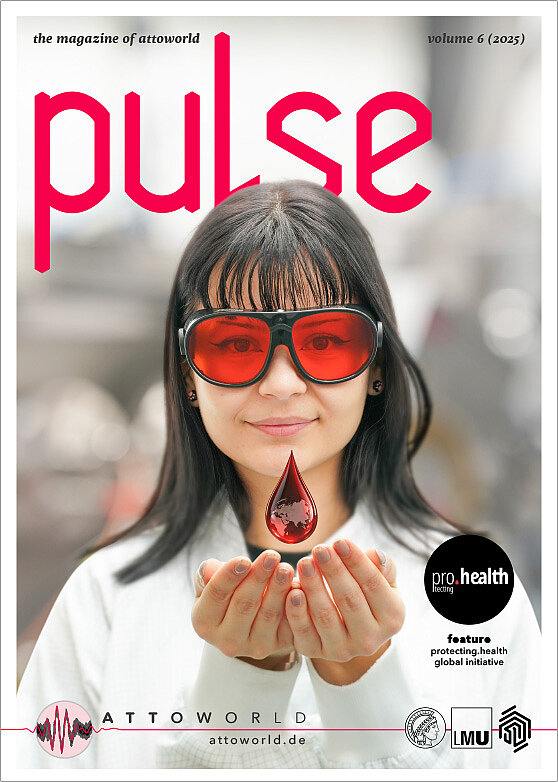 January 27, 2026 // Pulsepulse volume 6 – the magazine of attoworld
Will we soon be reaching for the stars? It is hard to imagine. After all, the nearest solar system, Alpha Centauri, lies 4.37 light-years away. Yet why not think boldly and consider how humanity might expand its boundaries?
In this issue, we explore concepts for generational spaceships developed by architects, social scientists, and engineers around the world. Such vessels could one day enable journeys to neighboring solar systems across many generations. Achieving this will require leaving our comfort zones, embracing new ideas, drawing on collective strengths, and overcoming established boundaries.
Pushing boundaries has always been one of physics’ defining qualities. While bound by the laws of nature, the limits of what is physically possible are far from exhausted. A striking example is the generation of attosecond light pulses in 2001. Nearly a quarter century later, this breakthrough has enabled unprecedented insights into intra-atomic processes and pushed imaging to the atomic scale. In recognition of its profound impact, attosecond science was awarded the Nobel Prize in Physics in 2023, honoring, among others, its pioneer Ferenc Krausz.
Physics is never a one-way street. Attosecond technology has also found applications beyond fundamental research. The attoworld-team employs laser-based methods not only to explore the microcosm, but also for infrared spectroscopy of molecules in blood. The aim is to develop a cost-effective diagnostic and early-detection tool for diseases such as cancer and diabetes – ultimately requiring only a single drop of blood.
What began as a visionary idea has since evolved into a global initiative, including large-scale studies and the protecting.health project. Its goal is to establish worldwide cooperation for an affordable health-screening approach that works across age groups, ethnicities, and countries, combining advanced physical technologies with artificial intelligence.
This issue of ‘pulse’ reflects the same spirit of exploration. Alongside scientific highlights from our researchers and alumni, it presents visionary projects and international collaborations, as well as the social engagement of the aid organization Science4People. Marking the centenary of quantum mechanics, the issue also explores its influence beyond science, with contributions examining its impact on abstraction in the arts and a featured scientific measurement image presented in an artistic context. Educational insights from PhotonLab, the attoworld student laboratory, together with personal perspectives from our team, complete this snapshot of the attoworld-community today.
And who knows – perhaps future generational spaceships will one day carry compact laser systems that monitor the health of their crews as they journey through the vastness of the universe.
-
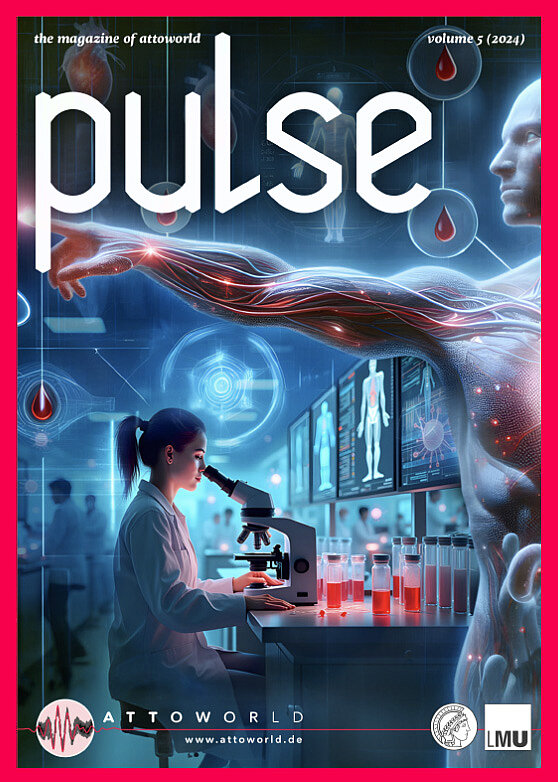 December 17, 2024 // Pulsepulse volume 5 – the magazine of attoworld
What do you think? Is this text my own work or was artificial intelligence used? It’s hard to say. I have asked myself this question in many of the articles I have read recently. But rarely have I found a clear answer. The fact is that the advance of artificial intelligence in every area of our lives is unstoppable. Be it in journalism, art, or science. Teachers, educators, and university lecturers are faced with the dilemma of recognizing AI in examinations and submitted work and evaluating it accordingly. Especially in work that claims to have generated new knowledge, this can be a challenging search for clues.
AI has become part of the attoworld- team’s toolkit as well. For Kosmas Kepesidis and his data science team, AI is a daily essential, and it has also proven useful for the team led by Andreas Döpp at CALA. In the years to come, AI will certainly transform our world, and only time will reveal the extent to which it enriches our lives.
But what AI can’t do — at least at the moment — is stand in the lab, experiment, try things out, and get creative. It’s not just the researchers in the attoworld-team who are way ahead of artificial intelligence. And that’s a good thing! Because this is the only way to generate new knowledge about the nature of things. Through people who are passionate about discovery and for whom science is an adventure. No AI in the world can conjure new scientific findings out of a hat. It can only help to structure and categorize them.
And so the public outreach team at attoworld is delighted to present you, dear colleagues, and hopefully many other people interested in laser physics, the new issue of our pulse magazine. AI has also found its way into this issue in many ways. However, the focus is on the meticulous research work carried out by the attoworld-team over the past year and the exciting findings that have been gathered in the process — with and without AI.
-
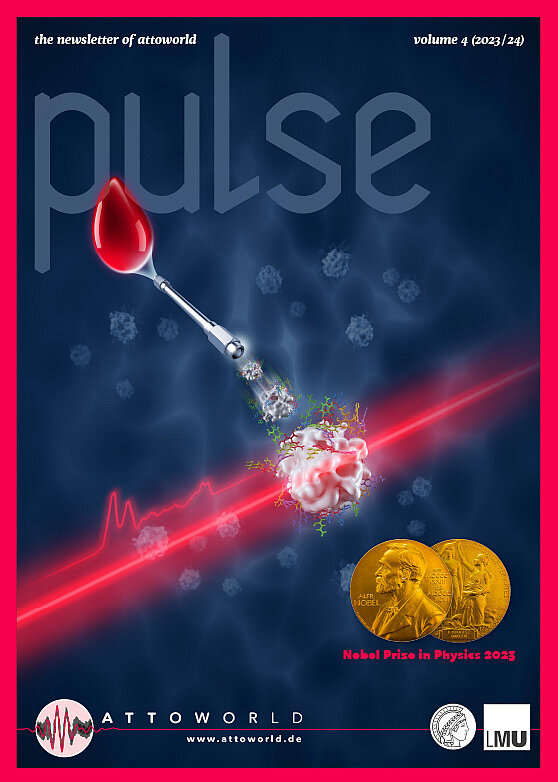 February 22, 2024 // Pulsepulse volume 4 – the magazine of attoworld
You are currently reading the latest issue of our a t t o w o r l d - magazine “pulse”. I am particularly pleased that so many former members of the a t t o w o r l d - team have contributedto this publication. Matthias Uiberacker, for example, looks back on the early days of attosecond physics when Ferenc Krausz and his group at the Vienna University of Technology generated the first attosecond flashes of light in 2001. Matthias was a young doctoral student at the time. This naturally gave him a very special perspective on the pioneering experiments of his long-established colleagues. It was an exciting time that laid the foundation for the prestigious Nobel Prize in Physics, which Ferenc Krausz received in 2023. Shawn Sederberg invites you to visit Canada and get an idea of his work there in a very personal article. And finally, Marcus Ossiander reports on his research into meta-optics.
Our magazine thrives on the diversity of expertise of the group members, who have once again gone to great lengths to contribute exciting articles in this issue. Artificial intelligence is covered as well as topics from the fields of medicine, optics and, of course, ultrafast physics. There is also a colorful potpourri of hopefully entertaining and exciting articles from the editors of the PR-team.
We wish you an entertaining read and hope you enjoy browsing through the new magazine
-
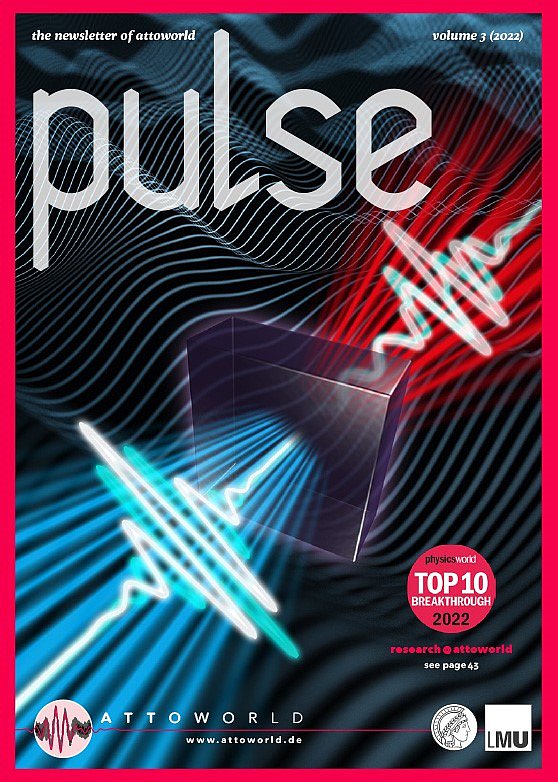 December 19, 2022 // Pulsepulse volume 3 – the magazine of attoworld
Welcome to the latest issue of “pulse”, the magazine of the attoworld team. As you browse through this issue, one thing will be sure to strike you: The range of topics covered in the articles has reached an enormous breadth.
We have attracted a wide variety of authors to contribute to this publication. Starting with our core business, attosecond physics, through medical issues, to artificial intelligence. But art and culture in connection with the natural sciences are also a topic, as is the communication of science by our school laboratory PhotonLab, which now inspires even school beginners for physics with a specially designed audio play. Likewise, we naturally want to keep them up to date on our aid activities in Ukraine, as the article on the “Science 4 People” initiative founded by Ferenc Krausz and his team shows. All of this adds up to a broad spectrum that our authors deal with. And they are all part of the attoworld team.
This shows us once again that a colorful mix is the quintessence. Ultrafast laser science combines the most diverse disciplines in our group. Here, laser physicists work together with biologists, chemists, and IT professionals. They are supported by a great administrative team, by an extremely skilled technical team, as well as by PR- and knowledge transfer experts.
-
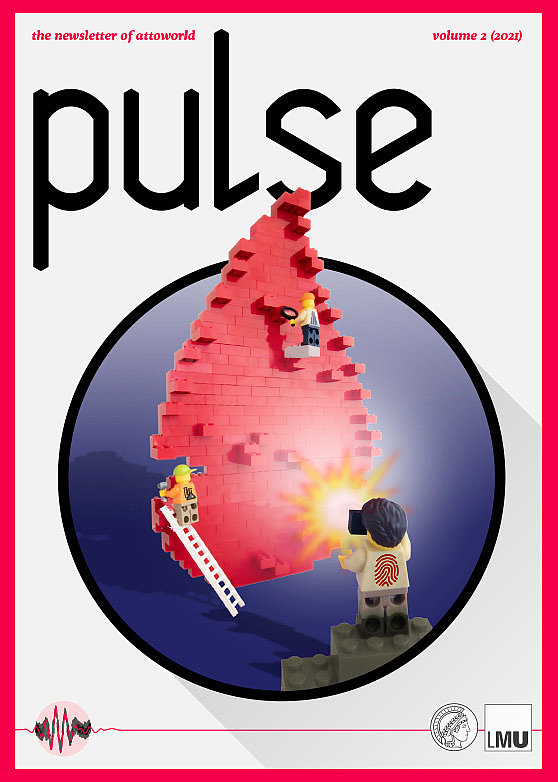 October 5, 2021 // Pulsepulse volume 2 – the magazine of attoworld
We have all come up against them – the challenges that test us to the limit – where success seems highly unlikely, if not wholly unattainable. But instead of throwing in the towel in such situations, it’s a good idea to step back and take stock. For centuries, humanity’s desire to know has proven again and again that what at first seemed impossible is in fact feasible. The essence of science is its ability to find ways of extending the limits of the possible. A willingness to set ambitious goals, explore unorthodox ideas and ignore conventions can serve as a powerful motivator. It can open up unexpected routes to new insights, even when the final outcome remains in doubt. The history of the Natural Sciences has repeatedly demonstrated that obstacles can be overcome, provided one has the required tenacity and open mindedness. Whether one regards a given task as ‘impossible’ or ‘perhaps feasible’ is often a matter of imagination. If one opts for the latter alternative, it helps to think outside the box, question accepted models, reconsider the fundamentals and seek unconventional solutions that no one else has hit upon. We take pride in the fact that, as members of the ATTOWORLD team, we have the opportunity to probe the limits of the possible. How can we control the behaviour of light with even greater precision? How far can we push the limits of ultrashort-pulse spectroscopy in practice? What sorts of applications might such advances make possible – which may now seem illusory, but might well have a significant impact on our future? In their contribution to this issue of pulse, Ioachim Pupeza, Alexander Weigel and Kafai Mak provide insights into their work at the forefront of laser physics. In this spirit, we urge you to nurture your sense of wonder and thirst for knowledge. Have the daring to make a difference in your quest to discover what lies beyond the current frontiers of laser physics, and help to shape our common future.
-
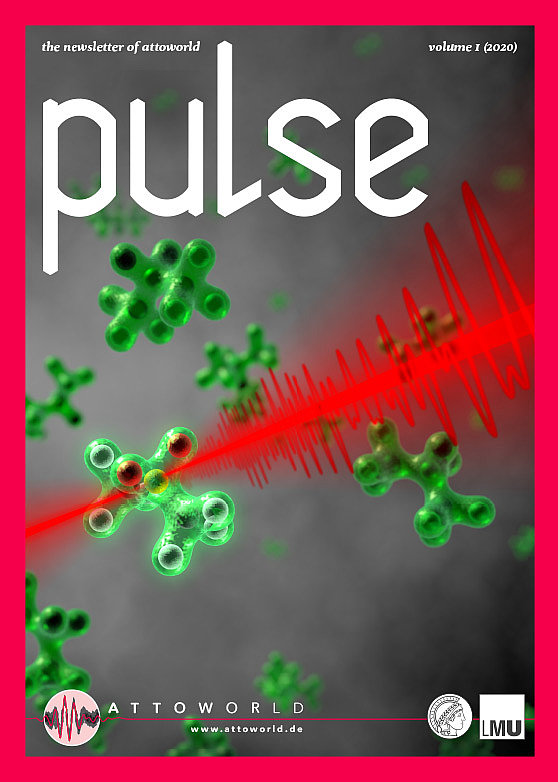 December 10, 2020 // Pulsepulse – the newsletter of attoworld
What do you think? Is this text my own work or was artificial intelligence used? It’s hard to say. I have asked myself this question in many of the articles I have read recently. But rarely have I found a clear answer. The fact is that the advance of artificial intelligence in every area of our lives is unstoppable. Be it in journalism, art, or science. Teachers, educators, and university lecturers are faced with the dilemma of recognizing AI in examinations and submitted work and evaluating it accordingly. Especially in work that claims to have generated new knowledge, this can be a challenging search for clues.
AI has become part of the attoworld- team’s toolkit as well. For Kosmas Kepesidis and his data science team, AI is a daily essential, and it has also proven useful for the team led by Andreas Döpp at CALA. In the years to come, AI will certainly transform our world, and only time will reveal the extent to which it enriches our lives.
But what AI can’t do — at least at the moment — is stand in the lab, experiment, try things out, and get creative. It’s not just the researchers in the attoworld-team who are way ahead of artificial intelligence. And that’s a good thing! Because this is the only way to generate new knowledge about the nature of things. Through people who are passionate about discovery and for whom science is an adventure. No AI in the world can conjure new scientific findings out of a hat. It can only help to structure and categorize them.
And so the public outreach team at attoworld is delighted to present you, dear colleagues, and hopefully many other people interested in laser physics, the new issue of our pulse magazine. AI has also found its way into this issue in many ways. However, the focus is on the meticulous research work carried out by the attoworld-team over the past year and the exciting findings that have been gathered in the process — with and without AI.


