join us

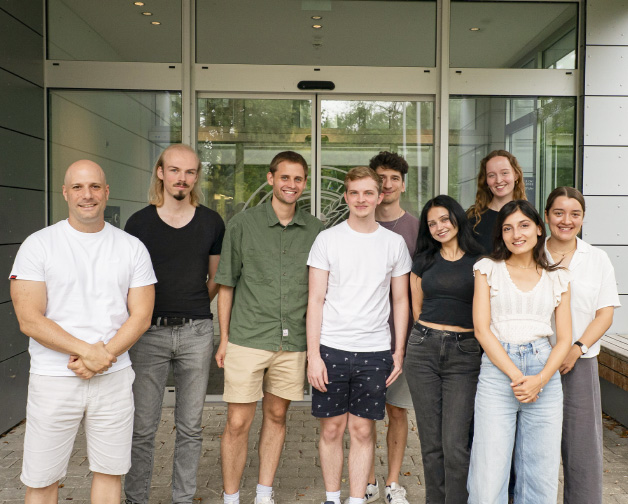
We are always looking for curious and motivated people who are excited to work at the intersection of artificial intelligence, data science, precision medicine, and physics.

Whether you are a student in data science, physics, statistics, or a related quantitative field, or a researcher in the life and molecular sciences, we welcome individuals who share our ambition to develop rigorous, data-driven approaches to better understand human biology and advance human health.

If you are passionate about interdisciplinary research that combines advanced measurement technologies, computational and statistical methods, and biomedical science, we would be delighted to hear from you.

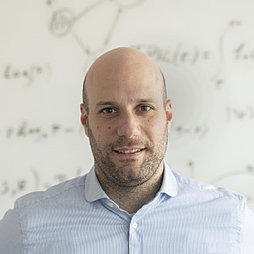
Contact: Dr. Kosmas Kepesidis
Email: kosmas.kepesidis@physik.uni-muenchen.de


  • M.Sc. // Master’s Thesis Position: Personalized Reference Intervals from Multimodal Molecular Data

    The Data Science Research Group invites applications for a Master’s thesis project on the theoretical and computational development of personalized reference intervals using longitudinal multimodal data from the Health4Hungary–Hungary4Health (H4H) study.

    more
    Scientific motivation

    Clinical measurements are commonly interpreted using reference intervals derived from populations. Such intervals may overlook biologically meaningful changes within an individual: a measurement can remain within the population range while deviating substantially from that person’s usual physiological state. Longitudinal molecular profiling creates an opportunity to define individualized baselines and detect departures from personal physiological normality.

    Research objectives

    The project will investigate how personalized reference intervals can be estimated from repeated measurements and extended from individual clinical variables to high-dimensional molecular profiles. Possible objectives include:

    1. quantifying intra-individual and inter-individual variability across molecular data modalities;
    2. estimating personal baselines and dynamically updating them as new measurements become available;
    3. distinguishing analytical variation, physiological rhythms, gradual trends, and potentially meaningful deviations;
    4. developing personalized prediction intervals or anomaly scores for sparse and irregular longitudinal data;
    5. integrating routine clinical laboratory measurements, infrared molecular fingerprints, proteomics, and metabolomics; and
    6. benchmarking personalized approaches against population reference intervals and conventional change-based criteria.

    Particular attention may be given to calibration, uncertainty quantification, missing data, batch effects, temporal drift, and the number of observations required to construct a reliable personal baseline.

    Methodological focus

    Depending on the student’s interests, the work may involve hierarchical or mixed-effects models, Bayesian inference, state-space models, Gaussian processes, time-series analysis, change-point and anomaly detection, representation learning, or multimodal latent-variable models. Methods will be evaluated through held-out longitudinal measurements, simulation studies, coverage and calibration analyses, and robustness tests.

    Expected qualifications

    Applicants should be enrolled in a Master’s program in physics, biophysics, quantitative biology, mathematics, statistics, computer science, or a closely related quantitative field. A strong foundation in statistics, probability, data analysis, or machine learning is expected. Experience with Python or R is highly desirable. Previous work with biomedical or omics data is helpful but not required.

    Skills developed

    The student will gain experience in longitudinal biomedical data analysis, personalized modeling, multimodal machine learning, uncertainty quantification, reproducible computational research, and the critical interpretation of statistical models in a health-monitoring context.

    Contact:
    Dr. Kosmas Kepesidis
    kosmas.kepesidis@physik.uni-muenchen.de

    less

  • M.Sc. // Master’s Thesis Position: Causal Generative AI for Counterfactual Modeling of Healthy Aging and Disease Transitions

    The Data Science Research Group invites applications for a Master’s thesis project on causal generative artificial intelligence for simulating individualized molecular trajectories and hypothetical interventions using multimodal data from the Health4Hungary–Hungary4Health (H4H) study.

    more
    Scientific motivation

    Observational data can reveal associations between molecular measurements and health states, but many scientifically important questions are counterfactual: How might the molecular phenotype of a particular individual have evolved under different conditions? What changes would be expected following a hypothetical intervention? Which molecular signals might precede or accompany a transition from health toward disease?

    Such questions are challenging because the same individual cannot be observed simultaneously under factual and alternative conditions. Causal generative models offer a computational framework for constructing these individualized scenarios while making the underlying assumptions explicit.

    Research objectives

    The project will design, implement, and train models capable of generating plausible counterfactual molecular states or trajectories. Possible objectives include:

    1. learning representations that separate stable individual characteristics from time-varying physiological conditions;
    2. incorporating causal graphs or structural assumptions into generative models;
    3. implementing the abduction-action-prediction framework for individual-level counterfactual inference;
    4. simulating interventions on selected clinical or molecular variables while preserving non-intervened characteristics;
    5. modeling healthy aging and hypothetical health-to-disease transitions;
    6. comparing alternative causal generative architectures; and
    7. using generated counterfactuals to formulate experimentally testable hypotheses.

    The analysis may combine routine laboratory measurements, infrared molecular fingerprints, proteomics, metabolomics, demographic variables, and longitudinal information.

    Methodological focus

    Candidate approaches include conditional diffusion models, causal variational autoencoders, normalizing flows, structural causal models, representation learning, and probabilistic deep learning. Evaluation will go beyond visual or distributional realism and may assess composition, reversibility, intervention effectiveness, minimality, individual consistency, temporal plausibility, and sensitivity to alternative causal assumptions.

    Because counterfactual conclusions depend on assumptions that may not be identifiable from observational data alone, careful model criticism and uncertainty analysis will be central to the project. Generated scenarios will be treated as research hypotheses rather than clinical predictions.

    Expected qualifications

    Applicants should be enrolled in a Master’s program in physics, biophysics, quantitative biology, mathematics, statistics, computer science, or a related quantitative discipline. A solid background in machine learning, probability, linear algebra, and programming is expected. Experience with Python and a deep-learning framework such as PyTorch or JAX is desirable. Prior knowledge of causal inference or generative modeling is advantageous but not essential.

    Skills developed

    The student will develop expertise in causal inference, modern generative AI, multimodal representation learning, scientific machine learning, model evaluation, GPU-based computation, and responsible interpretation of counterfactual models in biomedicine.

    Contact:
    Dr. Kosmas Kepesidis
    kosmas.kepesidis@physik.uni-muenchen.de

    less

  • M.Sc. // Master’s Thesis Position: Causal Relationships Across Blood-Based Molecular Data Modalities

    The Data Science Research Group invites applications for a Master’s thesis project on identifying and characterizing potential causal relationships across blood-based molecular data modalities collected in the Health4Hungary–Hungary4Health (H4H) study.

    more
    Scientific motivation

    Routine laboratory measurements, infrared molecular fingerprints, proteomic profiles, and metabolomic profiles provide complementary views of human physiology. Correlations across these modalities can reveal coordinated biological variation, but correlation alone cannot establish whether one molecular process influences another, whether the relationship is indirect, or whether both signals arise from a shared cause.

    Longitudinal multimodal data provide a promising setting in which to investigate directional dependencies and construct more mechanistic models of physiological regulation, healthy aging, and changes in health status.

    Research objectives

    The project will develop and evaluate computational strategies for causal analysis across molecular modalities. Possible objectives include:

    1. identifying stable cross-modal dependency structures;
    2. investigating whether temporal information and repeated measurements can help orient relationships;
    3. distinguishing direct associations from mediated effects and potential latent confounding;
    4. constructing interpretable causal graphs or molecular subnetworks;
    5. examining how inferred relationships vary across individuals, visits, demographic groups, or physiological states;
    6. comparing data-driven causal discovery with models informed by biological knowledge; and
    7. prioritizing robust, experimentally testable hypotheses for subsequent investigation.

    The work may address both individual molecular variables and lower-dimensional representations learned from high-dimensional proteomic, metabolomic, or spectroscopic measurements.

    Methodological focus

    Depending on the student’s background, the project may involve constraint-based and score-based causal discovery, structural causal models, probabilistic graphical models, dynamic Bayesian networks, mediation analysis, multivariate statistics, network science, multimodal representation learning, and invariant or longitudinal prediction methods.

    A major component will be evaluating the stability and credibility of inferred relationships. This may include bootstrap analysis, sensitivity to preprocessing and batch correction, comparison across visits or participant subgroups, negative controls, simulation studies, and explicit assessment of unmeasured confounding and identifiability. Where direction cannot be established from the available data, results will be reported as equivalence classes or competing causal explanations rather than overstated as definitive causation.

    Expected qualifications

    Applicants should be enrolled in a Master’s program in physics, biophysics, quantitative biology, mathematics, statistics, computer science, or a closely related quantitative field. Strong analytical and programming skills are expected, preferably in Python or R. Familiarity with statistics, machine learning, graphical models, network analysis, or omics data is beneficial. Curiosity about biological mechanisms and a willingness to engage critically with causal assumptions are especially important.

    Skills developed

    The student will gain experience in causal discovery, graphical and structural causal modeling, multimodal omics integration, longitudinal analysis, network interpretation, robustness assessment, reproducible research, and translating computational findings into biologically testable hypotheses.

    Contact:
    Dr. Kosmas Kepesidis
    kosmas.kepesidis@physik.uni-muenchen.de

    less

A mobile version for attoworld.de is under construction.