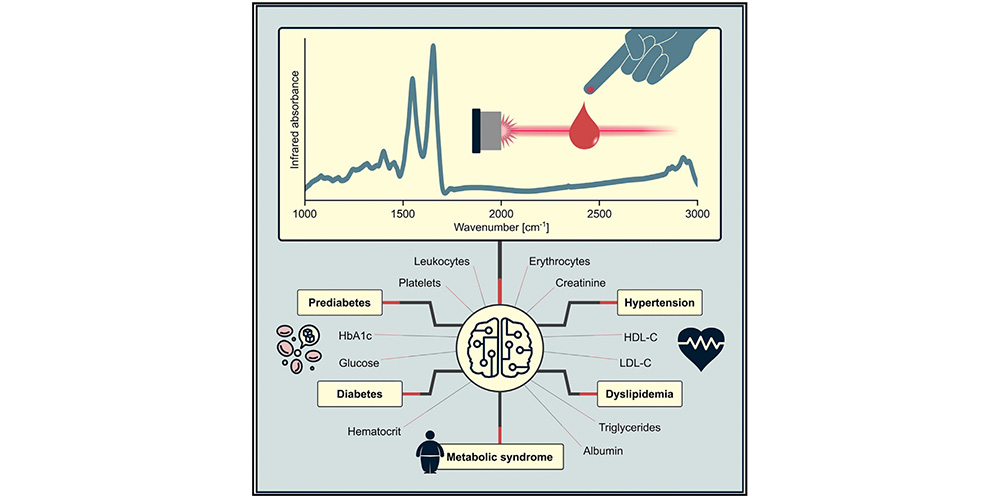




Routine laboratory measurements, infrared molecular fingerprints, proteomic profiles, and metabolomic profiles provide complementary views of human physiology. Correlations across these modalities can reveal coordinated biological variation, but correlation alone cannot establish whether one molecular process influences another, whether the relationship is indirect, or whether both signals arise from a shared cause.
Longitudinal multimodal data provide a promising setting in which to investigate directional dependencies and construct more mechanistic models of physiological regulation, healthy aging, and changes in health status.The project will develop and evaluate computational strategies for causal analysis across molecular modalities. Possible objectives include:
- identifying stable cross-modal dependency structures;
- investigating whether temporal information and repeated measurements can help orient relationships;
- distinguishing direct associations from mediated effects and potential latent confounding;
- constructing interpretable causal graphs or molecular subnetworks;
- examining how inferred relationships vary across individuals, visits, demographic groups, or physiological states;
- comparing data-driven causal discovery with models informed by biological knowledge; and
- prioritizing robust, experimentally testable hypotheses for subsequent investigation.
The work may address both individual molecular variables and lower-dimensional representations learned from high-dimensional proteomic, metabolomic, or spectroscopic measurements.
Depending on the student’s background, the project may involve constraint-based and score-based causal discovery, structural causal models, probabilistic graphical models, dynamic Bayesian networks, mediation analysis, multivariate statistics, network science, multimodal representation learning, and invariant or longitudinal prediction methods.
A major component will be evaluating the stability and credibility of inferred relationships. This may include bootstrap analysis, sensitivity to preprocessing and batch correction, comparison across visits or participant subgroups, negative controls, simulation studies, and explicit assessment of unmeasured confounding and identifiability. Where direction cannot be established from the available data, results will be reported as equivalence classes or competing causal explanations rather than overstated as definitive causation.
Applicants should be enrolled in a Master’s program in physics, biophysics, quantitative biology, mathematics, statistics, computer science, or a closely related quantitative field. Strong analytical and programming skills are expected, preferably in Python or R. Familiarity with statistics, machine learning, graphical models, network analysis, or omics data is beneficial. Curiosity about biological mechanisms and a willingness to engage critically with causal assumptions are especially important.
The student will gain experience in causal discovery, graphical and structural causal modeling, multimodal omics integration, longitudinal analysis, network interpretation, robustness assessment, reproducible research, and translating computational findings into biologically testable hypotheses.
kosmas.kepesidis@physik.uni-muenchen.de
less